Choosing the right mapping technology can shape the success of your project.
Whether you are working in forestry infrastructure construction or mining, the photogrammetry vs lidar debate comes up again and again.
Both methods deliver powerful spatial data, but they work very differently and serve different needs.
We believe that understanding how each technology performs in real conditions will help you best to make an informed decision.
What is Photogrammetry?
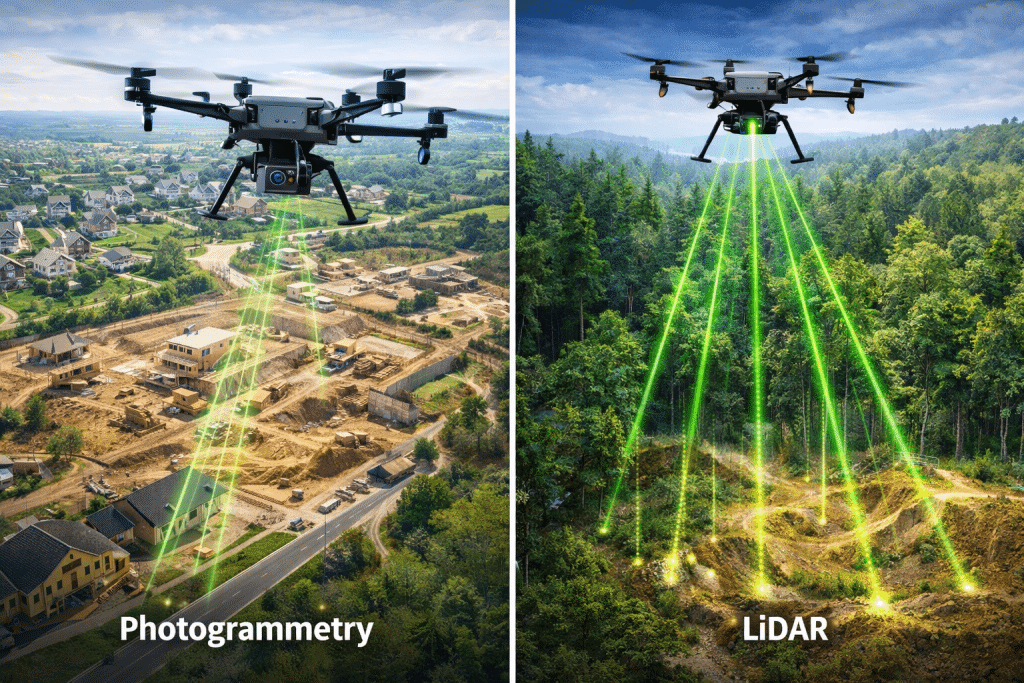
Photogrammetry is a mapping method that creates 3D models using overlapping images. These images are typically captured by drones or aircraft and processed through software to reconstruct surfaces and structures.
This approach works best when there is clear visibility of the ground or objects being mapped. As it relies heavily on light texture and surface detail to calculate depth and shape.
Photogrammetry is widely used in construction planning site monitoring and visual inspections. Because it produces highly detailed visuals that are easy to interpret and share with stakeholders.
However, its accuracy depends on lighting conditions, surface contrast and line of sight. As the dense vegetation shadows or uniform surfaces can greatly reduce reliability.
Learn about Aerial Photography.
What is LiDAR?
LiDAR uses laser pulses to measure distances between the sensor and the ground. A LiDAR system sends thousands of laser points per second and records how long it takes for each pulse to return.
This technology excels in complex environments. It can penetrate vegetation gaps and capture elevation data beneath forest canopies. That capability makes it especially valuable in forestry infrastructure corridors and terrain analysis.
Drone based LiDAR systems are commonly used across Canada where large forested areas, uneven terrain and remote access are common challenges.
LiDAR data is less dependent on lighting conditions and delivers consistent results even in low contrast environments.
Key differences in data capture
The core difference in photogrammetry vs lidar lies in how data is collected.
Photogrammetry depends on visible light and surface features. If the camera cannot see the ground clearly the data quality drops.
LiDAR directly measures distance using laser pulses. Even when the ground is partially hidden by vegetation the system can still collect elevation points.
This difference becomes critical in mapping technology comparison scenarios involving forests, powerline corridors, highways and floodplain studies.
Accuracy in real world projects
When discussing lidar vs photogrammetry accuracy context matters.
Photogrammetry can achieve high accuracy on open sites such as construction zones, stockpiles and building exteriors. With proper ground control it performs well for volume calculations and surface modeling.
LiDAR delivers superior vertical accuracy in complex terrain. It is particularly effective for slope analysis, drainage planning and infrastructure design in uneven or vegetated areas.
In Canadian forestry projects LiDAR is often preferred because it provides reliable elevation models without requiring land clearing or seasonal leaf off conditions.
Learn more about the growing demand of LiDAR services.
Performance in forestry applications
Forestry is where drone lidar vs photogrammetry differences are most visible.
Photogrammetry struggles in dense forests because tree canopies block visibility of the ground. This limits its usefulness for terrain modeling and forest inventory analysis.
LiDAR can capture multiple returns from a single laser pulse. Some pulses reach the forest floor while others reflect off branches and leaves. This allows accurate ground models, tree height measurements and biomass estimates.
For forest management, environmental assessment and infrastructure routing through wooded regions LiDAR consistently delivers more actionable data.
Infrastructure and construction use cases
In infrastructure and construction both technologies play valuable roles.
Photogrammetry is excellent for visual documentation, progress tracking and communication. Construction teams often use it to generate orthomosaics and realistic 3D site models.
LiDAR is preferred when precision matters more than visuals. Road design, rail corridors, bridge planning and flood risk analysis benefit from LiDAR accuracy and consistency.
Survey technology differences become especially important when working near slopes, waterways or existing utilities where elevation errors can cause costly issues.
Cost considerations and project scale
Cost is often part of the decision.
Photogrammetry systems are generally less expensive to deploy. Data processing is faster and equipment costs are lower. This makes photogrammetry attractive for smaller projects with clear visibility.
LiDAR systems involve higher upfront costs and more complex processing. However for large scale projects the value of accurate terrain data often outweighs the investment.
In remote Canadian regions where repeat site visits are difficult LiDAR can reduce long term costs by minimizing rework and uncertainty.
3D mapping methods compared
When comparing 3D mapping methods it helps to focus on outcomes rather than technology labels.
If your goal is realistic visuals, stakeholder presentations or surface level measurements, photogrammetry performs well.
If your goal is reliable elevation data, terrain modeling or analysis beneath vegetation LiDAR provides stronger results.
Many organizations now combine both methods to leverage the strengths of each depending on project phase and requirements.
Which one really wins – Photogrammetry or LiDAR
So which one wins in the photogrammetry vs lidar debate?
There is no universal winner. The best choice depends on terrain vegetation accuracy needs and project objectives.
For forestry infrastructure and large scale land analysis LiDAR often delivers more dependable results.
For construction visualization and open site mapping photogrammetry remains a powerful and efficient tool.
Working with experienced professionals helps ensure the right technology is applied at the right time.
Rekon Solutions supports projects across Canada by helping clients select mapping approaches that align with real conditions and regulatory requirements. Get in touch to discuss your project needs and we’ll show you which solution is best fit for you.
FAQs
What’s more accurate LiDAR or photogrammetry?
LiDAR generally offers higher vertical accuracy especially in vegetated or uneven terrain. Photogrammetry can be very accurate on open sites with good visibility.
What’s better than LiDAR?
No technology is universally better. In some construction and visualization tasks photogrammetry may be more practical and cost effective than LiDAR.
Is photogrammetry cheaper than LiDAR?
Photogrammetry is usually more affordable due to lower equipment and processing costs. However, total project value should be considered not just initial cost.
Is photogrammetry reliable?
Yes, photogrammetry is reliable when used in suitable environments with proper planning, ground control and lighting conditions.