Rivers are constantly changing. Water levels rise and fall, sediments shift, and channels reshape over time.
Yet many mapping projects still focus only on what is visible above the waterline.
This leaves a major gap in understanding the true structure of a river system.
Bathymetry fills that gap.
It reveals the underwater terrain that influences flow patterns, erosion, flood risks, and infrastructure planning.
Without bathymetry, river mapping is incomplete and decision making becomes less reliable.
Across Canada, where rivers play a major role in transportation, forestry, energy, and environmental management, accurate bathymetry is becoming essential.
What is bathymetry
Bathymetry refers to the measurement and mapping of underwater terrain. It is similar to topographic mapping on land, but instead of hills and valleys, it captures the depth and shape of the riverbed or lake floor.
River bathymetry helps engineers and environmental teams understand how water moves through a channel. It provides data on depth, slope, and underwater features such as sandbars, pools, and submerged structures.
This information forms the foundation for hydraulic modeling, infrastructure design, and flood risk assessments.
Why river mapping needs bathymetry
Traditional river mapping often focuses on the banks and surrounding terrain. While this information is useful, it does not reveal what is happening beneath the surface.
The shape of the riverbed directly affects
- Water velocity and flow direction
- Sediment transport
- Flood behavior
- Bridge and culvert performance
Without river bathymetry, models and designs rely on assumptions rather than real measurements. This increases uncertainty and can lead to costly mistakes.
How bathymetric lidar works
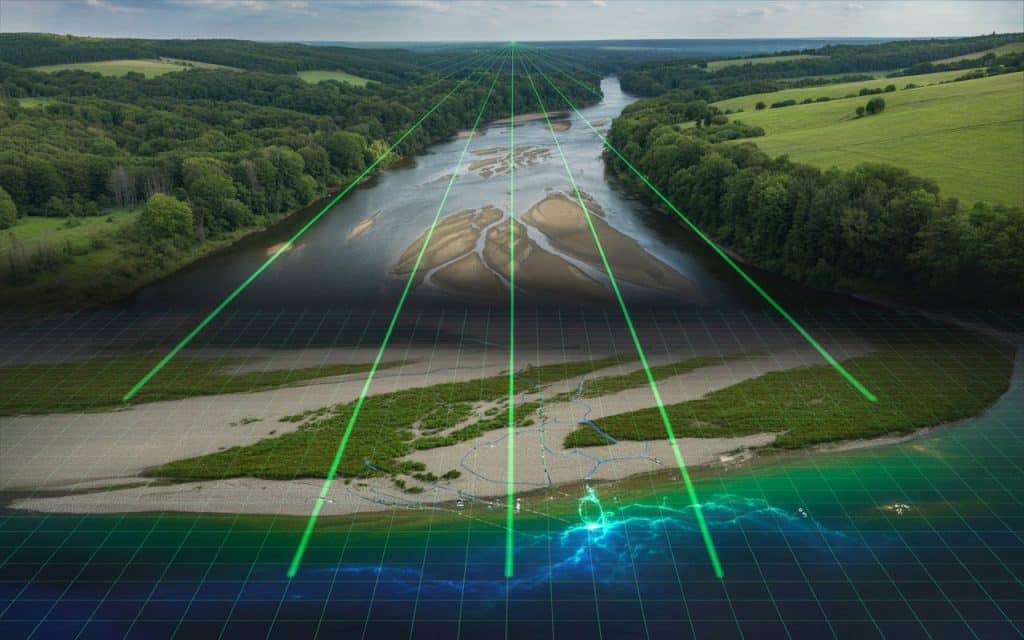
Bathymetric lidar is a technology that uses laser pulses to measure underwater depth. Unlike standard lidar, which reflects off solid surfaces, bathymetric systems use green wavelength lasers that can penetrate water.
The process works in two steps.
First, a laser pulse reflects off the water surface.
Second, part of that pulse continues through the water and reflects off the riverbed.
By measuring the time difference between these two reflections, the system calculates the water depth and creates an accurate underwater terrain model.
This approach allows for fast and efficient underwater terrain mapping across large river corridors.
Advantages over traditional hydrographic survey methods
Conventional hydrographic survey techniques often rely on boats equipped with sonar. While effective in certain conditions, these methods have limitations.
They can be slow in shallow or narrow channels. Access can also be difficult in remote or hazardous areas.
Bathymetric lidar offers several advantages
- Faster coverage over long river sections
- Reduced need for boats and physical access
- Safer data collection in remote or fast flowing areas
- Seamless integration with land based lidar data
These benefits make bathymetric lidar especially valuable for large scale water depth mapping projects.
Research insights on bathymetric mapping
Recent research highlights the growing role of lidar in river studies.
A study published in Journal of Hydrology found that lidar based river surveys improved the accuracy of hydraulic models by providing more detailed channel geometry. This led to better predictions of water flow and flood behavior..
Another research paper on small footprint green lidar showed that bathymetric lidar could successfully map riverbeds in clear water conditions while reducing the time required for field surveys.
A remote sensing study also demonstrated that combining bathymetric lidar with aerial imagery improved overall terrain models in river corridors.
These studies confirm that bathymetry is not just an added layer of information. It is a critical component of accurate river mapping.
Applications of river bathymetry
Bathymetric data supports a wide range of industries and projects.
Infrastructure planning
Bridges, culverts and pipelines often cross rivers. Accurate river bathymetry ensures these structures are designed with the correct depth and flow conditions in mind.
Flood risk analysis
Understanding underwater terrain helps predict how water will spread during high flow events. This is essential for floodplain mapping and community protection.
Environmental monitoring
Bathymetry reveals habitat conditions for fish and aquatic ecosystems. It also helps track erosion sediment buildup and channel changes.
Forestry and resource corridors
In forested regions, rivers often intersect access roads and utility lines. Water depth mapping ensures crossings are designed safely and efficiently.
Learn how UAV inspections reduce downtime for industrial operations.
Combining bathymetry with topographic data
One of the greatest strengths of modern mapping is the ability to combine land and underwater data into a single model.
By merging bathymetric lidar with standard lidar or photogrammetry, teams can create a complete representation of the river corridor.
This integrated approach provides
- Continuous elevation models from riverbank to riverbed
- Improved hydraulic simulations
- Better planning for infrastructure and environmental projects
The future of river mapping
As climate patterns shift and infrastructure demands grow, accurate river data will become even more important.
Bathymetry is no longer an optional layer. It is a fundamental part of understanding how rivers behave and how projects interact with them.
Across Canada, organizations are adopting bathymetric mapping to improve flood modeling, environmental assessments, and infrastructure planning.
Rekon Solutions supports these efforts by providing integrated mapping services that capture both land and underwater terrain.
FAQs
What is river bathymetry?
River bathymetry is the measurement and mapping of the depth and shape of the riverbed. It helps engineers and environmental teams understand underwater terrain.
What information is included in bathymetric data?
Bathymetric data includes water depth, riverbed elevation, underwater features, and channel shape.
How accurate is bathymetric mapping?
Accuracy depends on the technology and water conditions. Modern bathymetric lidar systems can achieve high accuracy suitable for engineering and environmental applications.
How to read a bathymetric map?
Bathymetric maps use contour lines or color gradients to show depth. Closer contour lines usually indicate steeper underwater slopes.