When it comes to infrastructure projects, maintaining safety and ensuring precision are key.
Traditionally, inspections were time-consuming, risky, and limited by accessibility.
However, aerial inspections are now revolutionizing the way projects are monitored, bringing higher efficiency and accuracy.
With the introduction of aerial inspection benefits through drones, complex and hazardous inspections are becoming safer, faster, and more reliable.
In this blog, we’ll explore why aerial inspections are gaining popularity and how they are enhancing infrastructure projects.
What Are Aerial Inspections?
Aerial inspections refer to the process of using unmanned aerial vehicles (LiDAR), or drones, to inspect infrastructure. These inspections use high-resolution cameras, sensors, and LiDAR technology to capture detailed data remotely.
Drones fly over and around structures, gathering visuals and measurements without direct human involvement in dangerous environments.
Compared to traditional methods, drones are more efficient in collecting large quantities of data quickly. Infrastructure drone inspection can cover vast areas and provide clear, high-resolution images for in-depth analysis.
Aerial inspections offer several aerial inspection benefits, such as speed, safety, and cost-effectiveness. Drones can easily access hard-to-reach areas like tall buildings or bridges, reducing the need for scaffolding, ropes, or ladders.
Key Benefits of Aerial Inspections
Faster Data Collection
Traditional inspections involve scaffolding, personnel, and heavy equipment. Whereas aerial inspections can survey large areas in minutes, providing real-time insights.
By capturing high-resolution images and video footage in minutes, drones make inspections more efficient.
Enhanced Safety
Aerial inspections reduce the need for workers to access dangerous or hard-to-reach places. Therefore, risk factors such as heights, confined spaces, and extreme weather conditions are minimized.
Moreover, using these bridge inspection drones for tall or hard-to-reach structures ensures the safety of personnel.
Cost-Effectiveness
Traditional inspection methods involve heavy equipment, personnel, and significant downtime.
In contrast, LiDAR inspection services reduce labor costs and increase overall productivity. These aerial inspections eliminate costly scaffolding setups and minimize project delays.
High-Quality Data
LiDAR are equipped with powerful cameras, LiDAR sensors, and thermal imaging systems. They capture accurate, high-quality data that supports better decision-making.
In addition, aerial inspection benefits include clearer, more detailed images that improve monitoring and analysis.
Aerial Inspections for Infrastructure Projects
Bridge Inspections
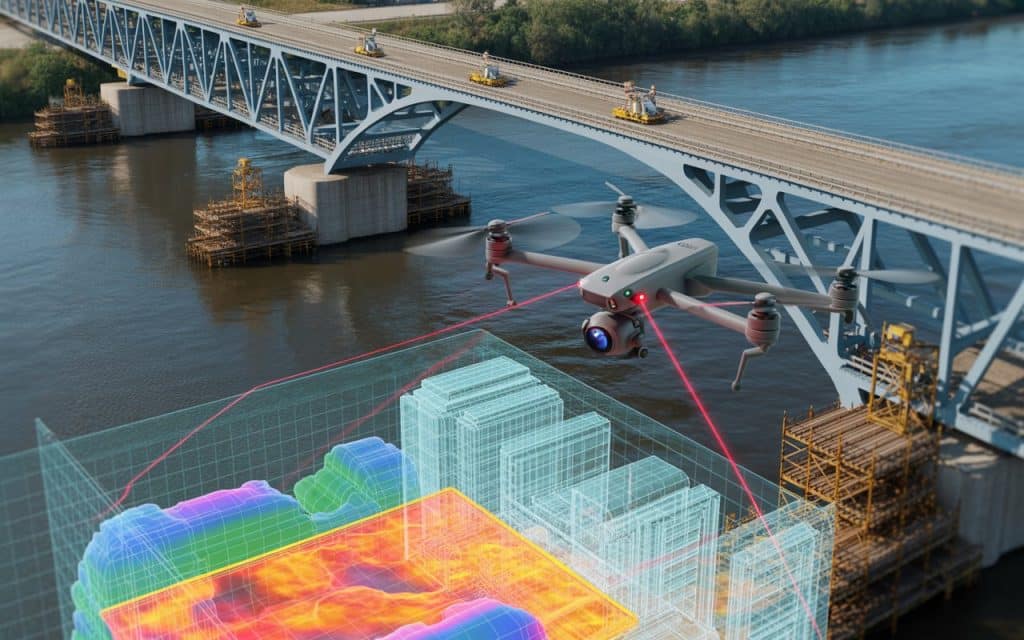
Bridge inspection drones are increasingly being used to inspect bridges and other elevated structures.
- Drones can fly around a bridge, capturing images and videos from multiple angles.
- They can quickly identify wear and tear, cracks, rust, or any structural issues that require attention.
Traditional bridge inspections often require workers to climb or use cranes, which can be time-consuming and risky. Drones, however, can complete inspections in a fraction of the time.
With aerial inspections, even the most complex and hard-to-reach parts of bridges can be assessed with minimal disruption.
Asset Inspections by Drone
Asset inspection by drone offers an efficient, accurate way to monitor infrastructure such as powerlines, communication towers, and wind turbines.
- Drones can access remote or difficult areas without risking worker safety.
- They capture high-resolution imagery that is useful for maintaining and managing these assets.
Drones can inspect large areas quickly, detecting potential issues such as corrosion, damage, or faults. This allows teams to address problems before they turn into costly repairs or safety hazards.
Aerial Inspections vs. Traditional Inspection Methods
When comparing aerial inspections to traditional methods, the advantages are clear. Traditional inspections typically involve more people, equipment, and manual labor, all of which increase the cost and duration of the process.
In contrast, drones offer a more streamlined approach:
Speed
- Drones can inspect large sections of infrastructure in much less time than traditional methods.
- For example, bridge inspection drones can capture detailed footage in a matter of minutes, while traditional methods could take hours or days.
Accuracy
- Aerial inspections provide precise, high-resolution images and data, reducing the chance for errors.
- Manual inspections are often prone to oversight or human error, especially in hard-to-reach areas.
Accessibility
- Drones can fly into places that would be difficult or dangerous for workers to access.
- This makes them ideal for inspecting high structures like communication towers, rooftops, and bridges.
Safety
- Traditional inspections often require workers to climb or rappel, which can be risky and labor-intensive.
- With drones, the need for workers to physically access hazardous locations is eliminated, reducing the chance of accidents.
Applications of Aerial Inspections in Infrastructure Projects
1. Structural Inspections
Drones can perform detailed inspections of buildings, bridges, and other structures. They are designed to capture high-resolution footage, allowing for a comprehensive assessment of structural integrity.
2. Thermal Inspections
LiDARs equipped with thermal imaging cameras can identify temperature variations in buildings, electrical equipment, or pipelines. This helps detect issues like heat loss, electrical faults, or insulation problems.
3. Monitoring Construction Progress
Drones provide aerial views of construction sites, tracking the progress of projects. They can monitor the site from different angles, comparing the actual progress with planned designs.
4. Environmental Monitoring
Drones can be used to monitor environmental factors that affect infrastructure. They can track vegetation, water levels, erosion, and other environmental elements that may impact long-term structural health.
Learn more about Aerial photography beyond media.
The Future of Aerial Inspections in Infrastructure
The future of LiDAR inspection services in infrastructure projects looks promising. During a forecast period (2025 – 2035), the aerial drone inspection industry is projected to expand at a CAGR of 17.6%. It explains the fact how efficient, safe and precise the inspection method is.
As technology advances, drones are becoming even more precise, capable, and autonomous. We can expect improvements in sensor technology, longer battery life, and more advanced data analytics.
Aerial inspections are already transforming the way infrastructure is inspected, maintained, and monitored. They will continue to replace outdated and risky traditional inspection methods, making infrastructure management safer and more reliable.
Get an instant quote for LiDAR services.
Frequently Asked Questions (FAQs)
What is the main benefit of aerial inspections?
Aerial inspections provide faster, safer, and more accurate data compared to traditional methods. They reduce the need for workers to access dangerous areas while ensuring high-quality data collection.
How do LiDAR inspection services improve safety?
LiDAR inspection services reduce the need for workers to physically access hazardous or hard-to-reach areas, minimizing the risk of accidents. This makes infrastructure inspections much safer.
Can aerial inspections replace traditional methods entirely?
While aerial inspections are becoming more common, traditional methods still have value in certain situations. However, drones are increasingly replacing manual inspections due to their speed, safety, and accuracy.
Are bridge inspection drones effective?
Yes, bridge inspection drones are highly effective in capturing detailed footage of bridges. They can quickly assess areas that are difficult to reach, offering high-resolution data for further analysis.
Moving Forward with Confidence
Aerial inspections offer significant advantages for infrastructure projects, from improved safety and speed to high-precision data collection.
As drones continue to evolve, they will play an even more important role in maintaining infrastructure and ensuring its longevity.
By embracing LiDAR inspection services, you can take your infrastructure projects to the next level.
Get in touch with our team today to learn how aerial inspections can support your next project and provide faster, more reliable insights.