For the first time, Canada has a national standard for controlling methane emissions from its landfills. On December 12, 2025, the federal government brought the Landfill Methane Regulations (SOR/2025-279) into force — a move years in the making, and one that will reshape how landfill owners and operators across the country monitor, control, and report the gas their sites produce.
If you operate a landfill, or work with clients who do, this is one of the most significant regulatory shifts the waste sector has seen in a decade. Here is what changed, why Canada acted, and what it means for the operators now on the clock.
The Short Version: What Actually Happened
Until now, landfill methane in Canada was governed by an uneven patchwork of provincial rules, voluntary programs, and offset protocols. Some provinces had meaningful requirements; others had very little. The new federal regulations replace that inconsistency with a single, country-wide baseline.
The approach is performance-based. Rather than dictating exactly which equipment every operator must install, the regulations set measurable limits — chiefly surface methane concentration thresholds — and require regular monitoring to prove those limits are being met. The regulations came into force in December 2025, but the heavier monitoring and control obligations phase in gradually between 2028 and 2035, giving operators time to design and install the infrastructure compliance requires.
Why Canada Tightened the Rules on Landfill Methane
The reasoning comes down to one uncomfortable fact: landfills are a bigger climate problem than most people realize.
Methane is a powerful greenhouse gas — responsible for roughly 30% of global warming since pre-industrial times — and it acts fast, trapping far more heat than carbon dioxide over the short term. In 2023, emissions from Canadian landfills accounted for about 17% of the country’s national methane emissions and roughly 3% of its total greenhouse gas emissions. That makes waste one of the largest single sources of methane in the country, behind only agriculture and oil and gas.
Canada has also made international commitments — including the Global Methane Pledge — to cut methane sharply this decade. Landfills represent one of the fastest and most cost-effective opportunities to do that. The gas is already being generated; capturing and destroying it (or converting it to energy) is comparatively cheap climate action with an immediate payoff. The regulations are designed to lock in those reductions: the target is to cut landfill methane by roughly 42% by 2030 and 50% by 2035, measured against 2019 levels.
Who the Regulations Apply To
The regulations do not apply to every landfill — they are aimed at the medium and large municipal solid waste (MSW) sites responsible for the bulk of emissions. A landfill is regulated if it meets either of these thresholds:
- Legacy waste-in-place: Received any MSW after January 1, 2010, and has more than 450,000 tonnes of waste in place; or
- Recent disposal volume: Disposed of more than 20,000 tonnes of MSW in 2025 or any later year, and has more than 200,000 tonnes of waste in place.
Meeting one of those thresholds triggers an obligation to assess methane generation using a mandatory federal modelling tool. Whether a site then faces full control obligations depends on how much methane it actually generates: open landfills above 664 tonnes per year and closed landfills above 1,000 tonnes take on further requirements. Sites that received only inert or non-biodegradable waste — soil, concrete, asphalt, glass, metals — are generally exempt, as are older portions closed before 2010.
What Operators Now Have to Do
For regulated landfills that cross the generation thresholds, the core obligations fall into a few clear categories:
- Model methane generation annually, using the ECCC Landfill Methane Modelling Tool.
- Monitor surface methane (Surface Emissions Monitoring) three times per year to find fugitive “hot spots” in the landfill cover.
- Monitor the gas recovery wellfield monthly for pressure, oxygen, flow, and damaged components.
- Detect and repair equipment leaks three times per year, with a leak defined at 500 ppmv or more.
- Control venting and report annually, with recovered methane destroyed or used, and a report due June 1 each year once control obligations begin.
The surface monitoring piece is where the day-to-day work lives. The regulations set a hard limit of 500 ppmv at any single location and a 25 ppmv zone-average across roughly 4,500 m² zones. Exceed those, and corrective action is required.
The Deadlines Are Tiered — and Closer Than They Look
The control obligations don’t hit every site at once. They phase in based on how much methane a landfill generates and whether it already has gas recovery infrastructure. Sites generating 1,000 tonnes or more per year with existing recovery systems face control requirements first, in 2028. Sites at that generation level without existing systems follow in 2029. Smaller sites generating between 664 and 1,000 tonnes have until 2035.
That staggered structure is deliberate — it gives operators lead time to plan capital projects rather than forcing an overnight scramble. But it also means the largest emitters have the least runway. If your site falls into the first tier, the design and installation work realistically needs to be underway well before the 2028 date, not started in response to it.
A Notable Detail: Drones Are Explicitly Allowed
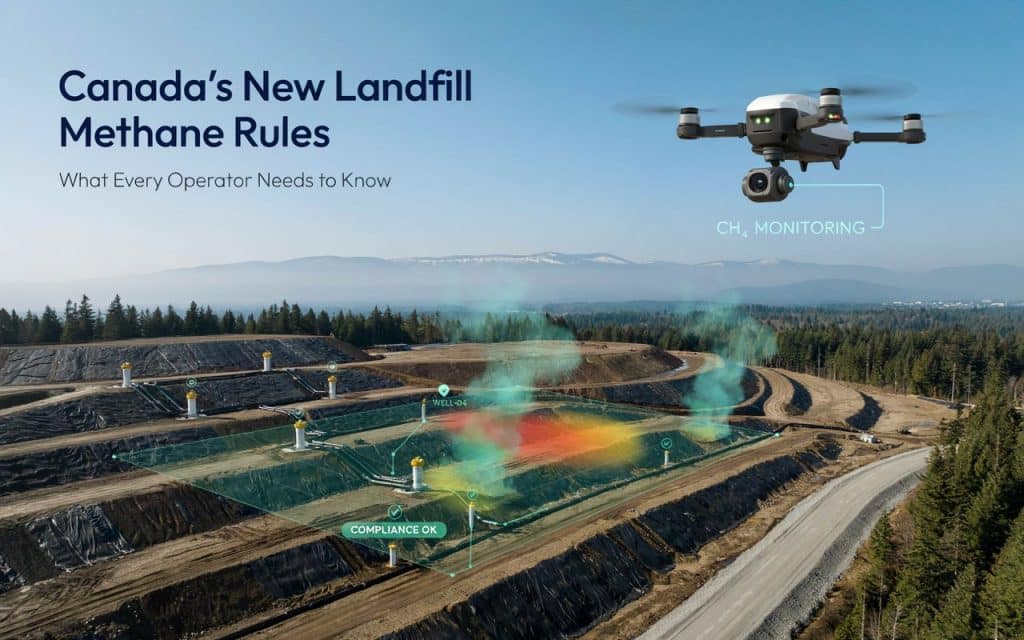
One forward-looking element of the regulations is worth flagging. For surface emissions monitoring, operators aren’t limited to crews walking the landfill on foot. The regulations explicitly permit drone-based monitoring using the US EPA’s OTM-51 method — a drone carrying a methane detector and a ground-level sampling tube.
For large or steep sites, this matters. A drone can cover ground faster than a walking crew and reach areas that are unsafe or impractical to survey on foot — steep slopes, drainage features, and unstable cover. Where the drone flags an elevated reading, a ground-based handheld check follows up to verify it. It’s a screening-and-verification workflow built for speed and coverage, and it reflects where the industry is heading. The same drone LiDAR and mapping technology used for topographic surveys can capture the site data operators need for waste-in-place figures and cover-integrity monitoring in the same visit.
OTM-51 isn’t the only drone-based approach. An alternative uses a drone-mounted laser methane detector — typically TDLAS technology — that measures the path-integrated concentration of methane in the column of air between the sensor and the ground, in units of ppm·m. That reading captures the laser’s entire path: any methane plume sitting near the surface, plus the ambient air above it. Practitioners in the United States have used the column laser to collect screening-level measurements over landfill surfaces, with follow-up by ground-based SEM — and work is underway on a standard method covering instrument specifications, calibration, and how measurements are collected and interpreted, mirroring what already exists for ground-based SEM and OTM-51.
One caveat: the regulations’ performance standards are concentration-based (ppmv), while the column laser reads path-integrated values (ppm·m) or emission rates (kg/h). To serve as an alternative SEM method, it must be described how elevated readings would be verified at the ground surface for comparison against those standards. Workable — just expect more setup than OTM-51.
What This Means for You
If you operate a landfill that meets the applicability thresholds, the most important thing to understand is that the clock is already running. The regulation is in force, assessment obligations have begun, and the control requirements arrive in 2028–2029 for the largest emitters. That may sound far off, but designing, installing, and validating a gas control and monitoring program takes years, not months.
The operators who fare best won’t be the ones scrambling in 2027. They’ll be the ones who understand their obligations now, get accurate baseline data on their sites, and build a repeatable monitoring program early — turning a regulatory requirement into a well-managed routine rather than a compliance emergency.
Want the full picture?
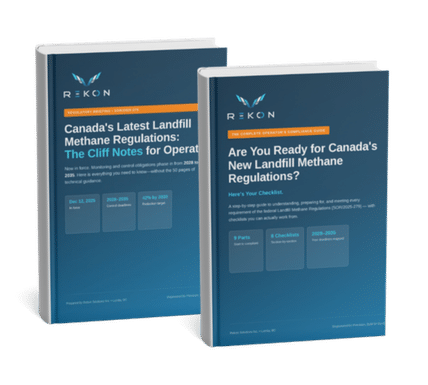
We’ve distilled the entire regulation into a plain-language operator’s briefing — every threshold, deadline, and requirement, without the 50 pages of technical guidance. Read the full summary in our free Cliff Notes guide.
And if you’d like to understand exactly where your site stands, book a free consultation — we’ll walk through your monitoring options and what compliance looks like for your specific operation.
Sources: Landfill Methane Regulations (SOR/2025-279), Canada Gazette, Part II; Environment and Climate Change Canada, Technical Guidance Document on Estimating, Measuring and Monitoring Landfill Methane (December 2025). This article is for information only and is not legal or regulatory advice; where any summary and the official regulation differ, the text of the Regulations governs.