
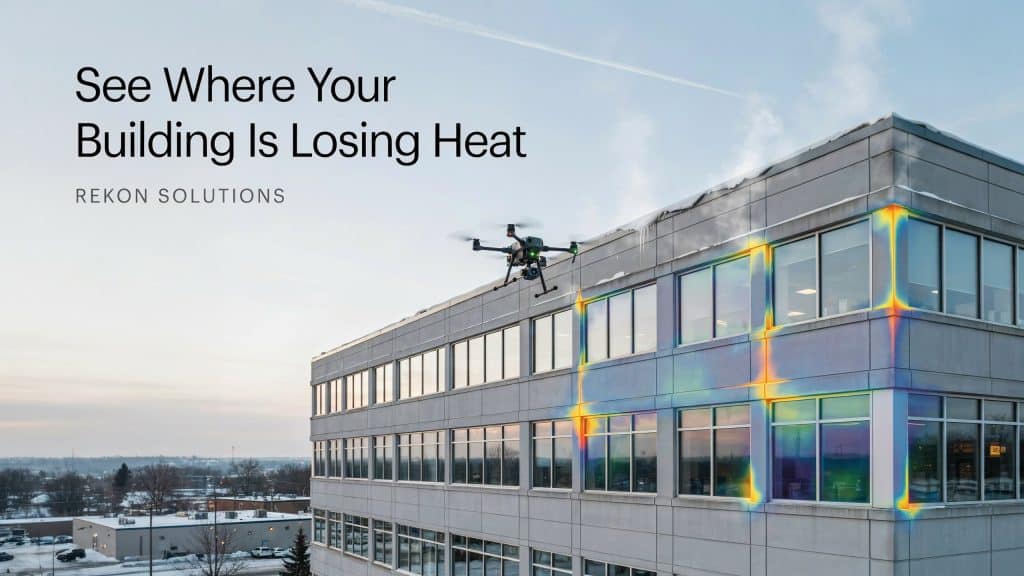
Your building is leaking money right now, and you cannot see a bit of it. That is the frustrating part of trying to detect heat loss in buildings with the naked eye.
Warm air escapes through gaps, thin insulation, and tired seals, all of it invisible until the bill arrives. Meanwhile, tenants complain about cold rooms and nobody can say exactly why.
Thermal drones change that. They make the invisible obvious, showing you precisely where the warmth is escaping.
The scale of the problem is worth knowing. Natural Resources Canada reports that walls alone can account for roughly 20% of a home’s heat loss, and that uncontrolled air leakage through the envelope can be the single largest source of all, according to NRCan.
So here is how a drone finds those losses, and what it can and cannot tell you.
How does a thermal drone find heat loss?
The idea is simple. Every surface gives off infrared energy, and a thermal camera reads that energy as temperature.
During a thermal drone inspection, the camera turns those readings into an image where warm areas glow bright and cool areas stay dark. On a cold day, a warm patch on an exterior wall means heat is escaping right there.
The drone flies the full building envelope, capturing roofs, walls, and upper floors that nobody can reach easily from the ground. That is the real advantage of infrared drone inspection, since it covers the whole surface in one pass.
You end up with a complete thermal picture of the structure. This is the fastest way to detect heat loss in buildings without scaffolding, ladders, or guesswork.
What can thermal imaging actually reveal?
Quite a lot, once you know how to read it. When you set out to detect heat loss in buildings, a thermal imaging drone building inspection commonly reveals missing or settled insulation, which shows as cold or warm patches in an otherwise even wall.
Air leaks are another classic find. Heat leak detection often shows plumes escaping around windows, doors, roof joints, and service penetrations, and those small gaps add up quickly.
You can also spot thermal bridging, where studs or steel carry heat straight through the envelope. Moisture shows up too, since damp insulation holds temperature differently than dry material.
Roofs are a big one. A building thermal inspection from above can reveal trapped moisture under membranes long before it becomes a leak, and that early warning alone can justify the flight. Together these findings explain most building heat loss.
What are the limits of infrared inspection?
Now for the honest part, because thermography is not magic. A drone thermal inspection depends heavily on conditions, and a bad day gives you a useless dataset.
You need a solid temperature difference between inside and outside, usually at least 10 degrees, which is why most attempts to detect heat loss in buildings happen in winter. Flights are best around dawn or after dark, once the sun has stopped warming surfaces.
Wind, rain, and direct sunlight all ruin the image. Sun heats a wall unevenly, so a bright patch may just be leftover solar gain instead of a fault.
Materials play tricks too. Shiny metal and glass reflect infrared, so a thermal camera reads the reflection rather than the surface. Interpreting these results takes training, which is where a skilled operator matters as much as the sensor. The same principle applies to any drone dataset, as we explain in our guide on how accurate drone LiDAR is for engineering and construction projects.
Why use a drone instead of a handheld camera?
Ground based thermography works, but it only sees what you can walk up to. A drone sees everything.
Roofs are the obvious win. Instead of putting someone on a ladder in winter, the drone flies the whole roof safely in minutes.
Height helps too. On a tall building, upper floors are simply out of reach from the ground, so an infrared building inspection from the air is the only practical way to cover them.
Speed is the other factor. An energy audit drone can capture a large facility or several buildings in a single visit, which makes an energy efficiency inspection realistic even across a whole portfolio. Flying is simply the most practical way to detect heat loss in buildings at that scale. Site conditions still shape the flight plan, much like any survey in challenging terrain, as we cover in our post on how LiDAR performs in dense forest and mountain terrain.
How do you turn thermal images into action?
Pretty pictures do not save energy. The value comes from what happens next.
A good thermal imaging inspection report marks each anomaly, notes its location, and ranks it by severity. That way you know which gap costs you the most and which can wait.
From there, findings become work orders. Seal these joints, add insulation here, replace that flashing, and check the roof section holding moisture.
The best programmes fly again afterwards. A follow up flight proves the repair worked, which turns heat loss detection building work into measurable results rather than hopeful spending. Rekon Solutions plans each thermal flight around your building, your conditions, and the decisions you need to make.
Frequently asked questions
1. When is the best time for a thermal building inspection?
Winter, on a cold, dry, calm day. Early morning or after dark is ideal, once the sun is no longer warming surfaces.
2. How accurate is thermal imaging for finding heat loss?
It reliably shows where temperature differences exist. It does not measure how much energy you are losing, so it points you to problems rather than quantifying them.
3. Can drones detect heat loss through windows?
Partly. Glass reflects infrared, so readings can mislead, though frames, seals, and surrounding joints usually show leaks clearly.
4. Does a thermal drone survey replace an energy audit?
No. It is a powerful diagnostic tool that shows exactly where losses occur, and it works best as part of a wider energy assessment.
Finding the losses you cannot see
Every heating season, buildings quietly lose energy through faults nobody has spotted. The only way to fix them is to find them first.
Thermal drones make that fast, safe, and thorough. You see the whole envelope, catch the biggest problems early, and spend your repair budget where it actually pays back.
If your building feels colder or costlier than it should, let us show you why. Tell us about your site and we will plan a thermal inspection that turns invisible losses into a clear list of fixes.