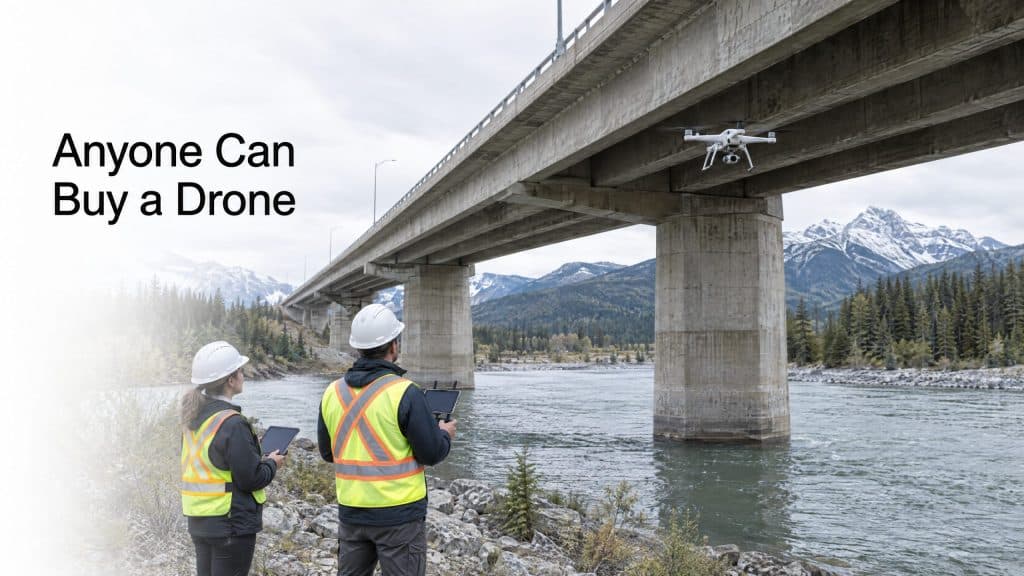
Anyone can buy a drone. That’s the uncomfortable truth behind the boom in drone inspection services. The barrier to owning the equipment has collapsed — but the barrier to doing the work well, safely, and legally hasn’t moved at all.
So when you’re choosing a drone inspection company for a bridge, a tower, a facility, or any critical asset, the question isn’t “can they fly a drone?” It’s “can they get me data I can actually make decisions on, without creating a liability I’ll regret?” Here’s how to tell the difference.
1. Start with the credentials that aren’t optional
In Canada, commercial drone operations are regulated by Transport Canada, and the pilots need the appropriate certification for the kind of flying your job involves. This is the floor, not a bonus. A provider who’s vague about their certifications, or waves the question off, is telling you everything you need to know.
While you’re at it, ask about insurance. Legitimate operators carry liability coverage appropriate to the work. If something goes wrong near your asset, you do not want to discover the operator wasn’t covered.
2. Look for experience that matches your problem
Inspecting a solar array is not the same as inspecting a bridge, a transmission tower, or a tunnel. Ask directly: have you done work like mine? A provider who understands your type of asset knows what failure modes to look for, what angles matter, and what “good data” even means for your decision.
This is where a provider’s background quietly matters. A team that came up through construction and heavy-civil engineering — as ours did — looks at a structure differently than someone who came to drones as a hobby. They know what an engineer actually needs to see, because they’ve been on the other side of that report.
3. Ask what you actually get — and whether you can act on it
A folder of nice photos is not an inspection. The real question is: what decision will this data let me make?
Good inspection work turns images into answers — flagged defects, measurable comparisons, and documentation that fits your maintenance or compliance workflow. Better still is a provider who can build a baseline and repeat it over time, so you’re tracking how an asset changes rather than guessing from one-off snapshots. That shift — from pretty pictures to decisions — is the whole point of a modern drone inspection.
4. Check how they handle the hard stuff
The assets that most need inspecting are usually the ones hardest to reach — confined, elevated, remote, or in GPS-denied spaces like tunnels. Ask how a provider handles those. The good ones have real answers (and real technology, like SLAM-based systems for GPS-denied environments). The rest get quiet.
5. Notice whether they’re honest with you
This one’s soft but telling. The best providers will sometimes tell you a drone isn’t the right answer, or refer you elsewhere when a job isn’t in their wheelhouse. That honesty is a feature, not a weakness. A company willing to send you to someone else when it’s right for you is a company you can trust when they say they can help.
Your drone inspection company checklist
- ✅ Proper Transport Canada certification for the operation
- ✅ Appropriate liability insurance
- ✅ Demonstrated experience with your asset type
- ✅ Deliverables you can act on — not just images
- ✅ A real approach to hard-to-access assets
- ✅ Straight answers, including when to say no
Run a prospective provider through that list. The right one will pass it without breaking a sweat.
Wondering if your inspection is a fit for us? Tell us about your asset →