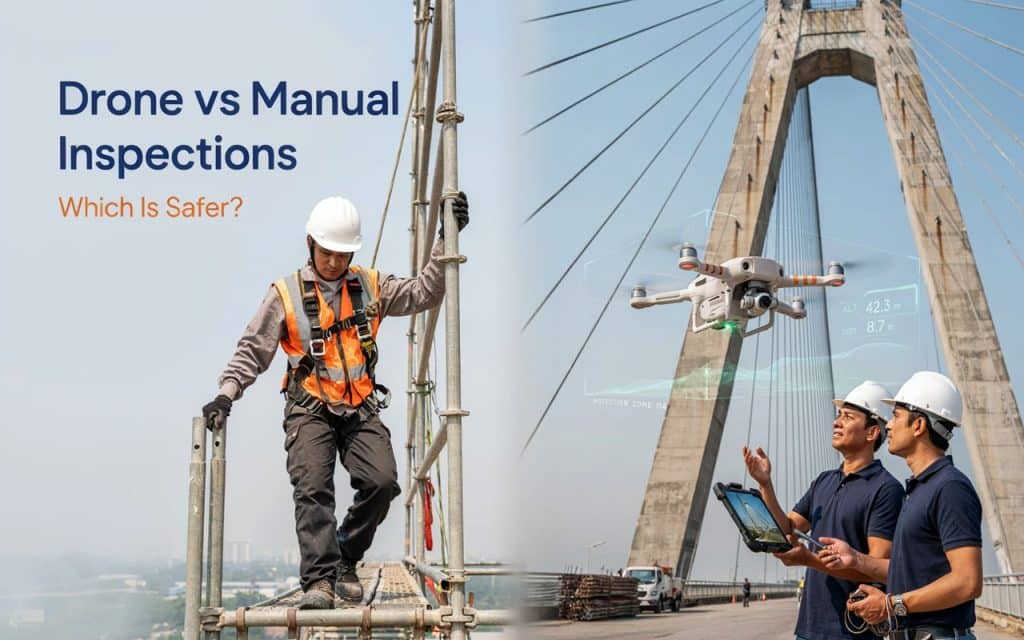
Ask anyone who has climbed a bridge pier in the rain and the drones vs manual inspections debate stops being theoretical. It becomes personal.
For decades, getting eyes on an asset meant putting a body next to it. Someone climbed, someone rappelled, someone squeezed into a confined space with a flashlight.
That worked, but it carried a cost that rarely showed up on the invoice. The risk sat with the person, not the equipment.
Drones changed that math. So let us look honestly at which method is safer, why the gap is so wide, and where a human still needs to be on site.
Why is manual inspection so risky?
The danger is not the inspection itself. It is the access required to perform it.
To reach a defect, a crew erects scaffolding, sets up rope access, or climbs a ladder onto a structure. Every one of those steps introduces a hazard that has nothing to do with the asset being checked.
The numbers are hard to argue with. In 2024, falls to a lower level killed 389 construction workers out of 1,034 total construction fatalities, making them the leading cause of death in the industry, according to U.S. Bureau of Labor Statistics.
Confined spaces add another layer. Tanks, tunnels, and vessels bring bad air, poor light, and difficult rescue. This is the real heart of the drones vs manual inspections question, because the traditional method asks a person to enter the risk zone before any data is collected.
Are drone inspections safer than manual ones?
Yes, and the reason is simple. The drone goes where the person used to go.
An inspection technique drone can hover beside a beam, fly under a deck, or circle a tower while your crew stands on stable ground. Nobody climbs, and nobody hangs from a rope.
That is real drone inspection risk reduction, not a marketing claim. Eliminating manual inspection hazards is not about managing a fall more carefully. It is about removing the fall hazard from the job entirely.
Traffic is another quiet win. Bridge inspections often need lane closures, which puts workers next to moving vehicles. Aerial work shortens or removes that exposure, and this is why drone inspection vs traditional inspection rarely ends in a tie on safety.
What are the safety risks of drones?
Fairness matters here, so let us be clear. Drones are not risk free, and any honest look at drones vs manual inspections has to admit that. They simply move the risk.
The main hazards are a flyaway, a battery failure, a collision with the structure, or a crash near people. The consequence is usually damaged equipment rather than a hospital visit, which is exactly the point.
Good drone inspection safety comes down to discipline. That means trained pilots, a preflight check, a planned flight path, weather limits, and clear exclusion zones on the ground.
The biggest problem with drones is not the aircraft at all. It is untrained operators flying without a plan, which is why the crew you hire matters as much as the hardware.
When do you still need a person on site?
Drones do not solve everything, and pretending otherwise helps nobody. Drones vs manual inspections is not a clean sweep, because some checks still need hands.
If a defect must be touched, sounded, or physically tested, a person has to reach it. Material sampling, bolt torque checks, and hammer sounding are still manual jobs.
Many teams now use a smart split. The drone screens the whole asset first, then people go only to the specific spots that need a closer look.
That approach is the real answer to drones vs manual inspections. You shrink the time at height instead of eliminating skilled inspectors, and the data quality improves at the same time. Accuracy still depends on capture and processing, which we cover in our guide on how accurate drone LiDAR is for engineering and construction projects.
How do you run a safe drone inspection?
A safe flight is a planned flight. Before takeoff, you scope the asset, check the airspace, and review the weather.
Then you set a ground exclusion zone, brief the crew, and run a preflight check on the aircraft and batteries. You keep the drone in sight and hold a safe distance from people.
Terrain and structures affect the plan too, since tight or cluttered sites demand more care. We explain how these systems handle difficult environments in our post on how LiDAR performs in dense forest and mountain terrain.
Experience is what ties it together. In drones vs manual inspections, the deciding factor is often the crew, not the kit. Rekon Solutions plans every inspection around your asset, your access constraints, and the safety of everyone on site.
Frequently asked questions
1. What is the 1 to 1 rule for drones?
It means your horizontal distance from uninvolved people should be at least equal to your flight altitude. Fly at 40 metres, stay 40 metres away, as EASA explains. It keeps people clear of the drop zone if the aircraft fails.
2. How do you make drone inspections safer?
Use trained pilots, run preflight checks, plan the route, respect weather limits, and set exclusion zones. Most incidents trace back to skipped planning, not faulty hardware.
3. What is the difference between manual and automated inspection?
Manual inspection relies on a person reaching and judging the asset directly. Automated inspection uses drones or software to capture and analyse data, keeping people out of the hazard zone.
4. How effective is manual inspection?
It is effective where touch and physical testing matter, and skilled inspectors remain essential. However, it is slower, costlier, and far riskier when access is the hard part.
Final Verdict: Which method should you choose?
If safety is your measure, the comparison is not close. Drones vs manual inspections comes down to one question, and that is whether a person needs to be in the hazard zone to get the data.
Most of the time, they do not. You get better coverage, a documented record, and a crew that goes home the same way it arrived.
The smartest programmes keep both. Fly first, then send people only where hands are truly required, so the exposure drops without losing expertise.
If you have an asset that is difficult or dangerous to reach, tell us about the access problem and what you need to know. We will plan an inspection that gets you the answer without putting anyone at risk.