
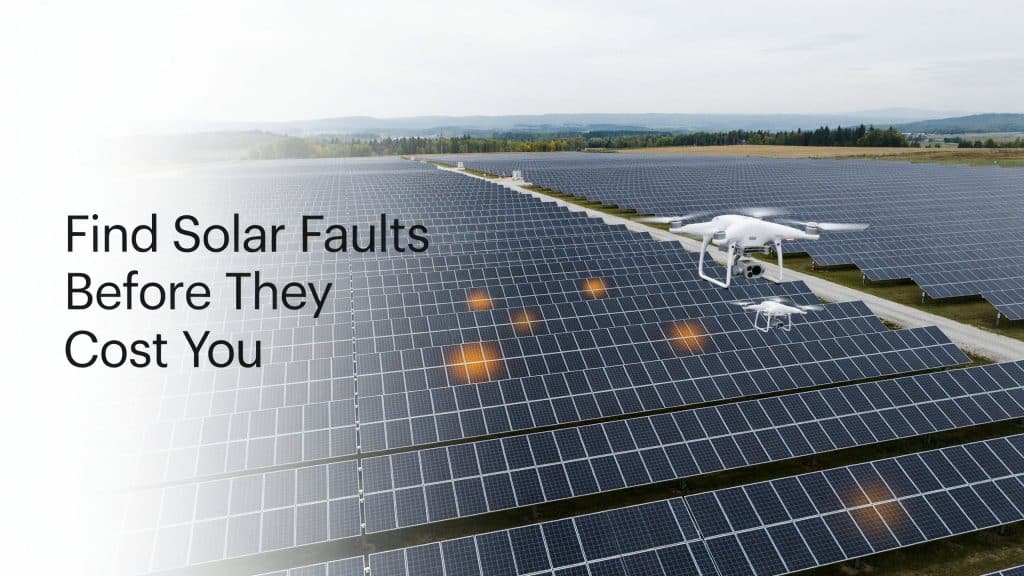
Drone thermography for solar farms has quietly become the smartest way to find faults. A modern solar site can hold hundreds of thousands of panels.
Checking each one by hand simply is not realistic anymore. That is where a thermal camera in the sky changes everything for you.
It spots failing panels from above, long before they drag down your output.
The scale keeps growing every single year, too. The International Energy Agency reports solar made up three-quarters of new renewable capacity.
With that much solar going up, faults multiply just as fast. So let me show you how this technology finds them at scale.
What is drone thermography for solar farms?
Let’s start simple, so we are working from the same page. Drone thermography for solar farms uses a heat sensing camera on a drone.
Every panel gives off heat, and a healthy one warms evenly. A fault, though, creates a hot spot that stands out clearly.
This solar panel thermal imaging turns invisible problems into obvious ones.
During a solar panel thermal inspection, the drone flies the whole array. It captures a thermal map of thousands of panels in one pass.
That makes drone thermography solar teams far faster than any ground crew.
Why do solar farms need thermal inspection?
You might assume a solar farm just runs quietly on its own. In reality, panels degrade and fail more often than people expect.
Even healthy panels lose a little output every single year. Hidden faults push that loss much higher, and you never see it.
A single failing module can drag down an entire string’s production. This is exactly why drone thermography for solar farms matters so much.
Good solar panel fault detection catches these losses before they add up.
Regular solar farm inspection protects both your energy yield and your revenue. Weather, wildlife, and wiring faults all take a toll over time.
What faults can thermal drones detect?
This is where thermal imaging truly earns its keep for you. A thorough solar panel inspection reveals a surprising range of problems.
Here are the faults a thermal drone commonly flags.
- Hot spots, where cells overheat and fail early
- Bypass diode failures, shown as warm patterned blocks
- Potential induced degradation, or PID, across full modules
- Cracked cells, soiling, and shading losses
- Loose or corroded electrical connections
A drone solar panel inspection even flags faults you cannot see from the ground.
We explain more in what drone inspections detect. That breadth is what makes drone thermography for solar farms so powerful.
How does inspection at scale actually work?
Drone thermography for solar farms was built for exactly this kind of scale. A Solar Farm Drone Inspection starts with a planned, automated flight path.
The drone flies steady lines and images every row in order. A single drone solar farm inspection can cover megawatts in one day.
Software then analyses the thermal data and locates each fault precisely. You receive a clear map showing exactly which panels need attention.
This makes drone inspection for solar farm sites fast and repeatable. You compare results over time and catch problems before they worsen.
What do you receive after the inspection?
A flight only helps you if the report is clear and usable.
A strong deliverable package usually includes several things.
- A thermal map of the whole site, fault by fault
- Every problem pinpointed by location and severity
- Plain guidance on which panels to fix first
- Side by side visual and thermal images
That way, your maintenance crew heads straight to the right panels. Good reporting turns raw heat data into a simple action list.
What is the best drone for solar inspection?
You are probably wondering which drone you actually need here. Honestly, there is no single best drone for solar inspection.
The right choice depends on your site size and your goals. You want a reliable radiometric thermal sensor for accurate readings.
Good flight time and automation matter more on very large sites. But the pilot and the analysis matter more than the aircraft.
A skilled drone solar inspection team turns raw heat maps into decisions. The tools behind drone thermography for solar farms keep improving fast.
A solar panel inspection with drone tools is only as good as its reading. Accuracy has real limits, which we explain in how accurate drone inspections are.
Frequently asked questions
How often should you inspect a solar farm?
Most operators inspect at least once a year for full coverage. Larger or older sites often benefit from more frequent checks.
Can drones inspect solar panels at night?
Thermal work is usually done in strong sunlight, not in darkness. Panels need heat and load for faults to show up clearly.
How accurate is drone thermal inspection?
With a good sensor and clear conditions, it is highly reliable. It locates faults precisely, though exact severity may need a closer look.
Does thermography find every solar fault?
It catches most thermal faults, but not every electrical issue. Pairing it with data analysis gives you the fullest picture.
Protect your output at scale
Your solar farm is a serious investment that truly deserves protection. Every undetected fault quietly chips away at your energy and revenue.
Drone thermography for solar farms finds those faults fast, across the whole site. For Canadian operators, drone solar panel inspections Canada wide are now common.
You get clear answers without walking a single row of panels.
If you run a solar site, this is the smart place to start. Tell us about your array and the output you want to protect.
Rekon Solutions will inspect it at scale and pinpoint every fault. Get in touch with your product details.