
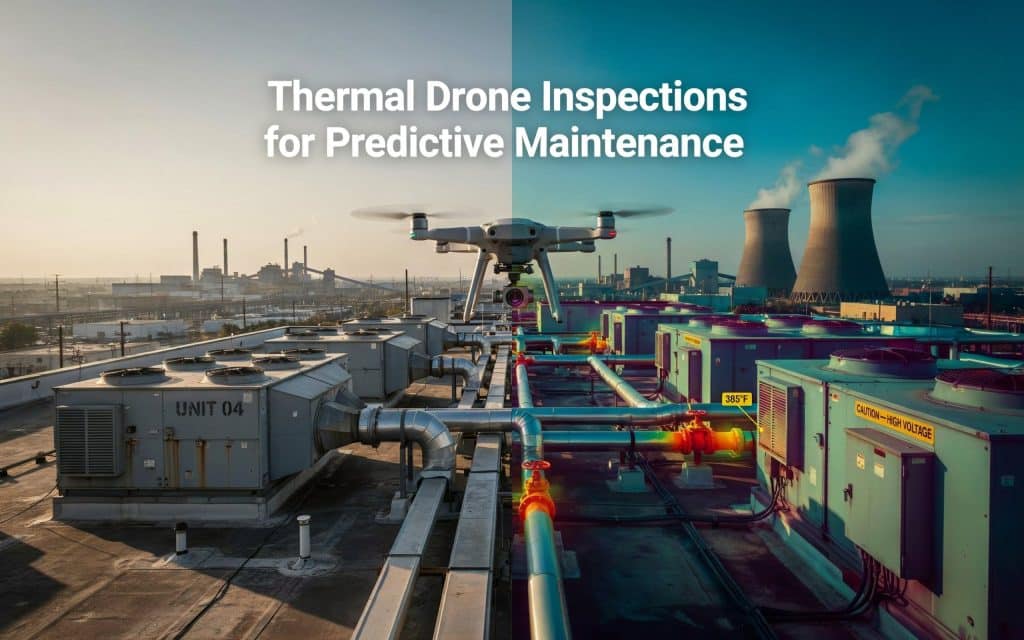
Imagine your industrial facility’s HVAC system suddenly failing during a heatwave, causing major downtime and damage.
What if you could have detected the fault before it happened, preventing the disruption and saving thousands of dollars?
This is exactly where thermal drone inspection comes in.
By using advanced infrared thermography surveys, thermal drones can quickly identify problems. It can detect defects like heat loss, electrical faults, and structural issues before they lead to expensive breakdowns.
Thermal imaging for infrastructure is changing the game for asset managers and facility operators, allowing for early detection and predictive maintenance.
In this blog, we’ll explore how thermography helps prevent costly failures and keeps operations running smoothly.
What is Thermal Drone Inspection?
Thermal drone inspection is the process of using drones equipped with thermal cameras to capture infrared images of equipment, buildings, or infrastructure. These images help identify temperature variations that can indicate potential issues. The issues may include electrical faults, heat loss, or moisture problems.
Unlike traditional visual inspections, thermal drones allow inspectors to quickly scan large areas without disrupting operations.
The high-resolution thermal imaging they provide reveals subtle temperature differences that are invisible to the naked eye. But, most often, those turn out to be the first signs of underlying issues.
For instance, in electrical systems, infrared thermography surveys can detect overheating components, loose connections, or circuit overloads before they lead to equipment failure.
In industrial facilities, thermal imaging for infrastructure ensures that systems run efficiently and avoid costly downtime.
How Thermography Prevents Costly Failures
The ability to detect problems early with thermal drone inspection offers significant advantages for businesses. Whether it’s a heat loss detection issue in a building or electrical fault detection in a factory, thermography helps avoid breakdowns. Where these breakdowns could otherwise result in expensive repairs or unsafe working conditions.
Studies have shown that implementing predictive maintenance techniques, like infrared thermography, can reduce downtime by up to 50% and lower maintenance costs by 30%.
When you can identify and fix problems before they disrupt operations, you prevent costly failures, reduce unplanned maintenance, and extend the lifespan of critical assets.
Predictive Maintenance Technology
Thermal drone inspections are a key component of predictive maintenance technology. Predictive maintenance relies on data and diagnostics to predict equipment failure before it occurs. By regularly using infrared thermography surveys, maintenance teams can monitor the health of machines and systems in real time, taking action before issues escalate.
For example, electrical faults are often preceded by increased heat in components, such as transformers or circuit breakers. Thermal imaging for infrastructure makes it possible to spot these hot spots early, allowing technicians to replace or repair components before they fail. This shift from reactive to proactive maintenance helps avoid emergency repairs and improves overall system reliability.
Applications of Thermal Drone Inspections
Heat Loss Detection in Buildings
Thermal drones are commonly used in energy audits to identify heat loss in buildings. By scanning building envelopes, drones can find areas where insulation is inadequate or air leaks are present. This information helps building owners improve energy efficiency, reduce heating and cooling costs, and ensure comfort for occupants.
Electrical Fault Detection in Industrial Settings
In industrial facilities, electrical systems are prone to overheating, which can lead to catastrophic failures if not addressed. Thermal drone inspection allows for quick detection of overheating components, identifying potential problems before they cause shutdowns or fires. This is particularly valuable in large facilities with complex electrical systems, where inspecting every component manually is both time-consuming and risky.
Infrastructure Health Monitoring
Drones equipped with thermal cameras can inspect large-scale infrastructure like bridges, dams, and pipelines. These structures are constantly exposed to environmental stress, which can lead to cracks, leaks, or corrosion. Using thermal drones to detect temperature anomalies can help identify areas of concern, ensuring that infrastructure remains safe and operational.
Mechanical Equipment Monitoring
Thermal imaging is also used to monitor mechanical equipment in factories or on construction sites. By identifying hot spots in motors, bearings, or pumps, thermography helps detect mechanical issues such as friction, misalignment, or lubrication failure. Addressing these issues early prevents more severe failures and extends the life of equipment.
The Advantages of Using Thermal Drone Inspections
The primary advantages of using thermal drone inspection include:
- Speed: Drones can quickly cover large areas, allowing for faster inspections than traditional methods.
- Safety: Drones can access dangerous or hard-to-reach areas, reducing the need for workers to put themselves at risk.
- Non-invasive: Thermal inspections are non-destructive, meaning that no physical contact is required with the equipment being inspected.
- Real-time data: Drones provide immediate feedback, enabling faster decision-making.
These benefits make thermal drones an indispensable tool in industries such as construction, energy, manufacturing, and infrastructure.
How Accurate is Thermal Drone Inspection?
The accuracy of thermal drone inspection depends largely on the quality of the drone’s thermal camera and the experience of the operator. High-end thermal cameras can detect temperature differences as small as 0.1°C, providing highly accurate readings.
However, while thermal drones are highly accurate, environmental factors can impact the results. For instance, extreme weather conditions, such as rain, snow, or direct sunlight, can affect the thermal signature of objects. It’s also important to note that infrared thermography surveys work best when the surface being inspected has a significant temperature difference from its surroundings.
With proper calibration and optimal conditions, thermal drones provide accurate, reliable data that can be used for preventative maintenance and asset management.
If you’re looking for more information on how drones are revolutionizing inspections, check out our blog on How Drone Inspections Improve Safety and Accuracy.
FAQs: Thermal Drone Inspections
How is thermal imaging used in inspections?
Thermal imaging uses infrared technology to detect temperature variations. In inspections, thermal drones capture infrared images of equipment, buildings, or infrastructure to identify issues like heat loss, electrical faults, or leaks that may not be visible to the naked eye.
How accurate is thermal drone inspection?
Thermal drones are highly accurate, with high-end thermal cameras capable of detecting temperature variations as small as 0.1°C. However, accuracy can be influenced by environmental factors such as weather conditions and the quality of the camera.
How can you improve the quality of thermal drone inspections?
To improve quality, ensure that thermal drones are properly calibrated, choose the right time for inspections (e.g., in the early morning or late afternoon when temperature differences are more pronounced), and use high-resolution thermal cameras.
Is LiDAR or thermography more accurate?
Both LiDAR and thermography have their strengths. LiDAR is used primarily for precise 3D mapping of the surface, while thermography excels in detecting temperature differences for identifying faults. They are often used together in comprehensive surveys to provide a complete view of the landscape.
Moving Forward with Confidence
Thermal drone inspection is more than just a tool for detecting problems; rather it’s an essential part of modern maintenance strategies.
Whether you’re looking to improve energy efficiency, detect electrical faults early, or monitor infrastructure health, drones offer a fast, safe, and non-invasive solution.
By integrating infrared thermography surveys and predictive maintenance technology into your operations, you can prevent costly failures, reduce downtime, and extend the life of critical assets.
If you are looking for reliable thermal drone inspection services, contact us to get a quote and details about our process.