
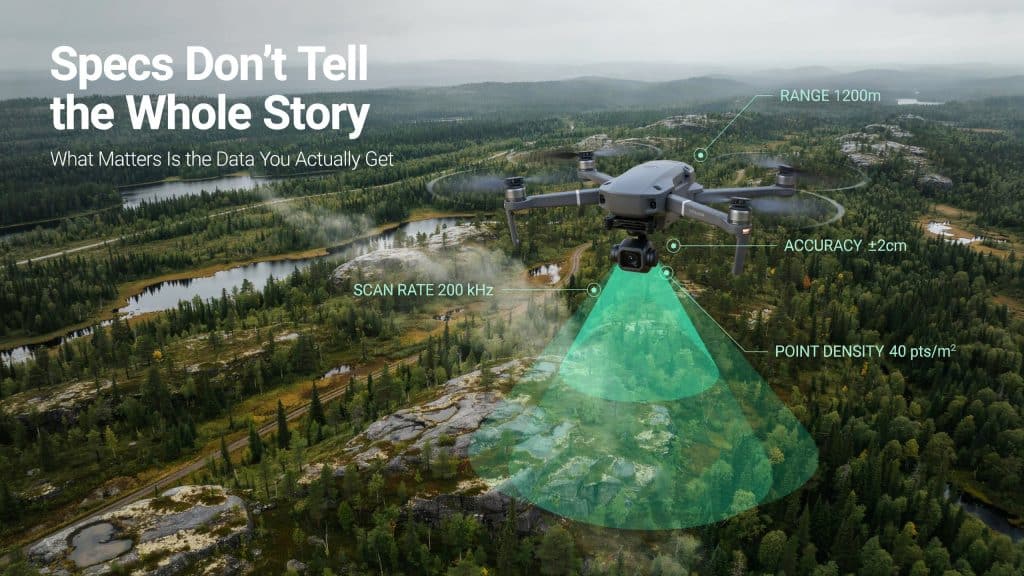
Have you ever chosen a sensor straight from its LiDAR spec sheet, picked the best numbers on paper, and still ended up with data that let you down?
You are not alone. That sheet is where almost everyone starts, and it is also where a lot of people get quietly misled.
Although those tidy figures for range, accuracy, and points per second look like promises. But, the truth is they are not accurate.
In fact, they are best case results from a controlled lab, and your muddy, tree covered, real world site looks nothing like a lab.
Here is the part nobody likes to say out loud. Independent testing by SPIE, the international optics and photonics society, found that lidars with similar advertised specifications often perform very differently in the field, according to SPIE.
So before you trust the numbers, let us break down what a spec sheet really tells you, and what it leaves out.
What is a LiDAR spec sheet actually telling you?
Think of it as a resume. It lists the highlights, in the best possible light, under the best possible conditions.
Most LiDAR specifications cover a handful of headline numbers. Range, accuracy, precision, points per second, and beam divergence are the usual suspects.
These LiDAR specs are real and useful. The trouble is what LiDAR specs mean in practice, because every one of them was measured under ideal conditions the manufacturer picked.
For example, a quoted range is usually tied to a specific target reflectivity, often as low as 10 percent, and a specific detection probability. And when you change the surface, the weather, or even the definition, that number will move a lot. That gap is why a LiDAR spec sheet is a starting point, not a guarantee.
Why do lab specs fall short in the field?
What’s important to keep in mind is that lab conditions are clean, but not your site.
Out in the field, LiDAR performance depends on things the sheet never mentions. Vegetation, dust, rain, standing water, dark surfaces, and steep angles all steal returns and soften your data.
This is exactly why two sensors with identical sheets can hand you very different results. Real LiDAR data quality is decided outside, on real ground, not inside a test chamber.
We show how much conditions matter in our post on how LiDAR performs in dense forest and mountain terrain, where a canopy changes everything. None of that shows up on the sheet.
What does the spec sheet leave out?
Here is where results are actually won or lost. The sensor is only one ingredient.
Ground control is huge. Without well measured control points, even a flawless scanner can drift, and no line on a page will save you. This is where real LiDAR accuracy is made.
Flight planning matters just as much. Altitude, speed, overlap, and scan pattern shape your point density far more than the raw points per second figure ever suggests.
Then there is processing. Classifying points, cleaning noise, and building surfaces is skilled work, and a weak workflow can waste a great sensor.
In practice, a solid LiDAR survey and clean LiDAR scanning depend on the whole system, not one number. We dig into that in our guide on how accurate drone LiDAR is for engineering and construction projects. This is the part the LiDAR spec sheet simply cannot show you.
How do you read and compare LiDAR specs the smart way?
So how do you use a spec sheet without being fooled by it? Start by reading the fine print.
When you learn how to read LiDAR specifications, always check the conditions attached to each number. Ask what reflectivity the range assumes and how the accuracy was measured.
For how to compare LiDAR sensors fairly, line up the same conditions side by side. Comparing a range quoted at 10 percent reflectivity against one quoted at 80 percent is not a comparison at all.
Then look past the LiDAR sensor specifications to the provider. The team flying, planning, and processing your job shapes the outcome more than any single number.
A tidy LiDAR Specifications Sheet means little if nobody behind it knows your terrain. That is how you make a LiDAR spec sheet work for you instead of against you.
Frequently asked questions
1. Can LiDAR see in the dark?
Yes. LiDAR makes its own light with a laser, so it works fine at night. Darkness does not affect it, which is a real advantage over cameras.
2. What can LiDAR not detect?
It struggles with clear glass, still water, and very dark or shiny surfaces, since the laser passes through or bounces away instead of returning.
3. Can you explain what LiDAR is and how it works?
LiDAR fires rapid laser pulses and times how long each one takes to bounce back. Those timings become millions of 3D points that map the surface in detail.
4. What confuses LiDAR?
Rain, dust, fog, reflective surfaces, and heavy vegetation all scatter or block the laser, which cuts returns and lowers accuracy.
Always buy the results, not the numbers
In the end, a spec sheet is a promise about a perfect day your project will never have. The numbers matter, but they are the floor, not the ceiling of what you get.
What actually lands on your desk depends on ground control, planning, processing, and the people doing the work. That is the whole difference between a beautiful LiDAR spec sheet and beautiful data.
If you want results you can trust, tell us about your site. Our team, at Rekon Solutions, will deliver LiDAR scanning services and LiDAR survey services tuned to your terrain, not to a lab. Discuss the project details now.