
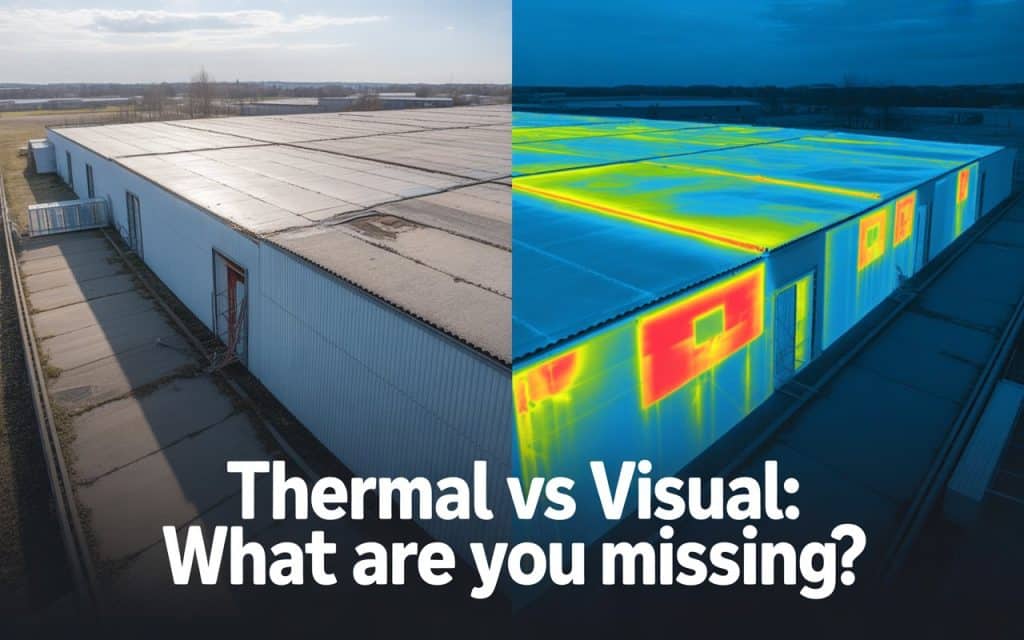
Many inspection programs rely heavily on what can be seen with the human eye.
Cracks, corrosion, missing components, and visible damage are all important indicators of asset condition.
However, not every problem is visible on the surface.
Some issues develop long before visual signs appear.
Heat loss, moisture intrusion, electrical faults, and insulation failures often remain hidden until they become costly problems.
This is where a drone thermal inspection offers a different perspective.
Rather than replacing visual inspections, thermal imaging adds another layer of information.
Understanding what each method can and cannot reveal helps organizations make better maintenance and inspection decisions.
Let’s compare both approaches and explore where each delivers the most value.
Why Visual Inspections Remain Important
Visual inspections have been the foundation of asset assessment for decades. They provide direct observation of physical conditions and help identify visible defects quickly. In many situations, they remain the first step in evaluating asset health.
Inspectors can identify:
- surface cracks
- corrosion
- loose components
- structural damage
- material deterioration
Visual inspections also provide context that helps interpret broader site conditions. This makes them valuable across infrastructure, construction, and industrial environments.
However, visual assessments are limited to what can actually be seen. Hidden defects often remain undetected until symptoms become more obvious.
What a Drone Thermal Inspection Reveals
A drone thermal inspection measures temperature variations across surfaces and structures. Instead of capturing only visible imagery, thermal sensors detect heat signatures that may indicate underlying problems.
This allows inspectors to identify issues that would otherwise remain invisible during standard inspections. Small temperature anomalies often reveal developing defects before visible damage appears.
For example, thermal inspections can detect:
- insulation failures
- moisture intrusion
- electrical hotspots
- heat loss
- mechanical overheating
This capability makes thermal technology particularly valuable for preventive maintenance programs.
Understanding Thermal Imaging vs Visual Inspection
The discussion around thermal imaging vs visual inspection is not about choosing one method over the other. Instead, it is about understanding how the two approaches complement each other.
Visual inspections reveal physical conditions directly. Thermal imaging reveals temperature patterns and hidden performance issues. Together, they provide a more complete understanding of asset health.
A visible crack may indicate structural deterioration. A thermal anomaly may indicate a hidden moisture issue beneath an apparently intact surface. Both findings are valuable but reveal different aspects of the asset.
The strongest inspection programs often combine both methods rather than relying on one alone.
How Drone Infrared Inspection Services Improve Detection
Modern drone infrared inspection services allow thermal data to be collected safely and efficiently from difficult locations. Roofs, towers, industrial facilities, and utility infrastructure can all be inspected without extensive physical access.
This improves safety while expanding inspection coverage. Inspectors gain access to viewpoints that may be difficult or costly to reach manually.
Additionally, drones can capture thermal imagery consistently across large areas. This helps create comprehensive records for comparison over time.
As assets age, these repeatable inspections become increasingly valuable for condition monitoring.
Further Reading: How Accurate Is Aerial Thermal Imaging Heat Loss Detection?
Building Heat Loss Drone Inspection Applications
One of the most common uses for thermal technology is building heat loss drone inspection. Energy loss often occurs through roofing systems, wall assemblies, windows, or poorly insulated areas.
These deficiencies may not be visible during conventional inspections. Thermal imagery highlights areas where heat escapes unexpectedly, allowing teams to identify opportunities for improvement.
For facility managers, this information supports:
- energy efficiency initiatives
- maintenance planning
- insulation assessments
- sustainability programs
By locating heat loss early, organizations can address inefficiencies before energy costs continue to increase.
Thermal Drone Survey Accuracy and What Affects It
Like any inspection method, thermal drone survey accuracy depends on several variables. Environmental conditions play a significant role in how thermal data is collected and interpreted.
Factors affecting thermal accuracy include:
- ambient temperature
- wind conditions
- solar exposure
- surface materials
- inspection timing
For example, inspections performed during peak sunlight may produce different thermal patterns than inspections conducted at dawn or dusk.
Experienced operators understand how these variables influence results. Proper planning helps ensure thermal findings accurately represent asset conditions.
How Infrared Thermography Drones Support Maintenance Programs
Modern infrared thermography drones have become valuable tools for proactive asset management. Instead of waiting for failures to occur, organizations can identify warning signs earlier.
Thermal inspections often reveal developing issues before visible symptoms emerge. This supports predictive maintenance strategies that reduce downtime and repair costs.
Common applications include:
- electrical system monitoring
- industrial equipment inspections
- facility management
- infrastructure maintenance
This early detection capability is one of the strongest advantages of thermal technology.
You can also learn more about How Drone Inspections Improve Safety and Accuracy.
Why Roof Thermal Inspection Is So Effective
A roof thermal inspection is one of the clearest examples of thermal imaging value. Moisture trapped beneath roofing materials often remains hidden during visual assessments.
As moisture affects thermal behavior, infrared sensors can identify areas requiring further investigation. This helps maintenance teams focus repairs where they are most needed.
Thermal inspections also reduce the need for extensive exploratory work. Instead of examining large roof sections manually, teams can target specific locations efficiently.
This improves both inspection speed and maintenance planning accuracy.
Energy Audit Drone Thermal Imaging Benefits
Organizations focused on energy efficiency increasingly use energy audit drone thermal imaging to evaluate building performance. Thermal data helps identify areas where energy losses occur throughout facilities.
This information supports:
- building performance assessments
- retrofit planning
- sustainability initiatives
- operational cost reduction
According to the MDPI report, correcting building envelope deficiencies can reduce heating and cooling energy usage by 15% to 30%.
Thermal inspections help provide the data needed to support these improvements.
Defect Detection Thermal Imaging Drones Can Improve
One of the strongest applications for defect detection thermal imaging drones involves identifying hidden conditions before they become visible failures. Temperature anomalies often act as early warning indicators.
Examples include:
- electrical overheating
- moisture intrusion
- insulation degradation
- mechanical stress points
While thermal imaging does not diagnose every issue directly, it helps identify areas requiring closer investigation.
This allows maintenance teams to allocate resources more effectively.
Construction Thermal Inspection Services During Project Delivery
Many organizations now use construction thermal inspection services during and after project completion. Thermal imaging helps verify insulation installation, identify moisture concerns, and assess overall building performance.
These inspections provide valuable quality control information before occupancy. Contractors and owners can address deficiencies earlier, reducing future remediation costs.
Thermal data also creates objective documentation that supports project verification efforts.
This additional layer of validation helps improve confidence in completed construction work.
Expanding UAV Thermal Mapping Applications
The range of UAV thermal mapping applications continues growing as sensor technology improves. Today, thermal drones support infrastructure inspections, industrial maintenance, environmental monitoring, and energy management initiatives.
The combination of mobility, efficiency, and data quality makes drones increasingly attractive for organizations seeking proactive inspection solutions.
As thermal technology advances further, its role within inspection programs will likely continue expanding.
If your organization is evaluating inspection options, Rekon Solutions can help determine whether thermal imaging, visual inspections, or a combination of both best supports your operational goals.
FAQs
Is thermal imaging better than visual inspection?
Neither method is universally better. Thermal imaging reveals hidden temperature related issues, while visual inspections identify visible physical defects.
What can a drone thermal inspection detect?
Thermal inspections can identify heat loss, moisture intrusion, electrical hotspots, insulation issues, and overheating equipment.
How accurate are thermal drone surveys?
Accuracy depends on sensor quality, environmental conditions, inspection timing, and operator expertise.
Can thermal imaging replace visual inspections?
No. Thermal imaging works best when combined with visual inspections to provide a more complete assessment.
Seeing More Than the Surface
Every inspection method has strengths and limitations. Visual inspections remain essential for identifying visible defects and understanding physical conditions. However, many important issues develop beneath the surface where they cannot be seen directly.
A drone thermal inspection helps reveal those hidden conditions before they become larger problems. By combining thermal and visual data, organizations gain a more complete understanding of asset health and performance.
The best inspection programs do not choose between thermal imaging and visual assessments. They use both strategically to improve safety, efficiency, and long term asset reliability.
When you can see both the visible and the invisible, better decisions become much easier to make.