Thermal imaging has a bit of a superpower reputation — point a heat camera at something and reveal its hidden secrets. There’s real truth to that. But thermal imaging also gets oversold, and setting honest expectations upfront is the difference between a survey that pays for itself and one that disappoints.
So let’s be straight about both sides: what drone thermal imaging genuinely detects, and where it runs out of road.
How it works, in one sentence
A thermal camera doesn’t see light — it sees heat, translating temperature differences into an image. Anything warmer or cooler than its surroundings shows up. That simple principle is the source of both its power and its limits.
What drone thermal imaging detects well
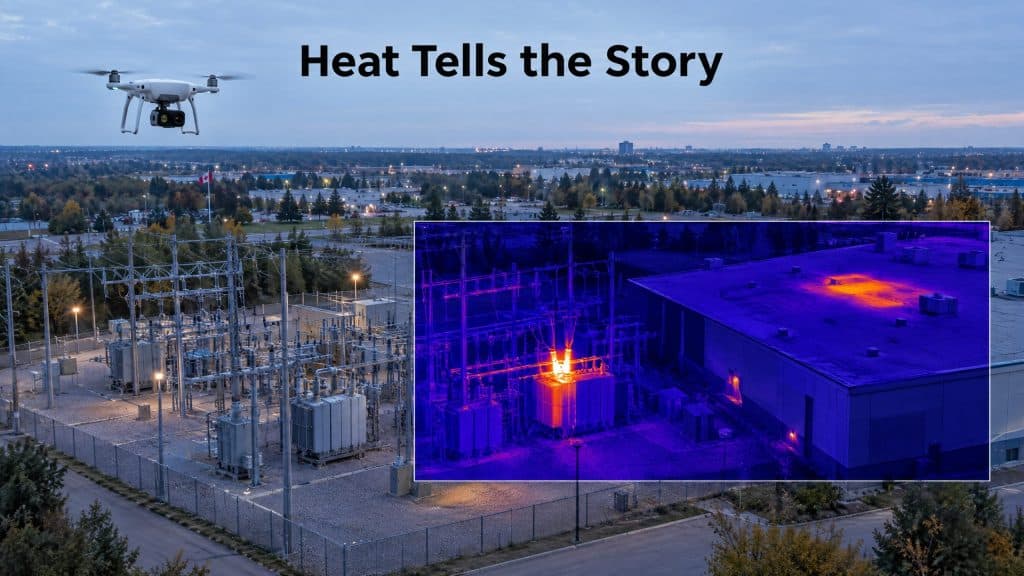
- Electrical faults. Overloaded connections, failing components, and hotspots on transformers or panels run hotter than healthy ones — often long before they fail. This is one of thermal’s strongest, most proven uses. A loose connection on a substation or electrical asset will light up clearly.
- Heat loss in buildings. Missing insulation, thermal bridging, and envelope gaps show as temperature patterns across a wall or roof — the basis of energy-efficiency surveys.
- Moisture and water intrusion. Trapped moisture changes how a surface holds and releases heat. A wet patch under a flat roof membrane often shows up thermally well before it ever stains a ceiling.
- Solar panel faults. Dead cells, bad connections, and hotspots across a large array are nearly impossible to spot on foot — but from the air, with thermal, they stand out immediately.
- Missing or struggling components. Anything that generates or holds heat differently than it should — pumps, bearings, mechanical systems — can reveal itself.
What it can’t do (and what oversells it)
- It doesn’t see through walls. This is the big myth. Thermal shows surface temperature. It can reveal what’s behind a surface only when that thing changes the surface temperature — it is not X-ray vision.
- Conditions make or break it. Thermal needs contrast. Scan a building at the wrong time of day, when indoor and outdoor temperatures have evened out, and you’ll see nothing useful. Timing, weather, sun load, and recent rain all matter enormously.
- It’s diagnostic, not always definitive. Thermal tells you where something’s off and prompts a closer look. It’s the powerful first pass, not always the final word — which is why it pairs so well with visual inspection.
- It has resolution limits. Very small anomalies at distance can fall below what the sensor resolves.
The real lesson: timing and expertise
Here’s what separates a thermal survey that delivers from one that wastes everyone’s time — and it’s not the camera. It’s when you fly and who reads the results.
The same asset scanned at the wrong hour can look perfectly fine when it isn’t, or throw false alarms when it’s healthy. Getting the conditions right — often early morning or after dark, when heat contrast is strongest — is half the skill. Interpreting the image correctly is the other half.
That’s why thermal imaging is best treated as a professional tool, not a gadget. Used well, it catches expensive problems while they’re still cheap to fix. Used carelessly, it produces a pretty picture that means nothing.
Wondering if thermal is the right tool for your problem? Let’s talk it through →